You are comparing two sauna brands on one narrow question: which delivers better red light therapy. The answer hinges on wavelengths, clinical proximity, and how tightly the light is integrated into the build, not on marketing copy.
This comparison breaks down wavelengths and clinical proximity, build quality, heater technology, EMF exposure, and pricing. You will get a clear verdict plus specific guidance on whether SaunaCloud or Sun Home Saunas fits your needs.
Quick Verdict: Sun Home Saunas vs SaunaCloud for Red Light Therapy
If you're prioritizing true clinical-proximity red light therapy integrated into an infrared sauna, SaunaCloud's design puts 660 nm and 850 nm LEDs just 2-6 inches from your skin, while Sun Home Saunas offers red light as an add-on feature with less emphasis on proximity.
That distance matters more than most buyers realize. Photobiomodulation depends heavily on how much light actually reaches tissue, and intensity falls off quickly with distance. LEDs mounted close to the body deliver a more concentrated dose than panels positioned farther away.
SaunaCloud builds its red light therapy directly into the benches and backrests, so the LEDs sit at clinical proximity of 2-6 inches during a normal session. You don't need to reposition a separate panel or angle your body toward a light source.
The heaters are equally central to the comparison. SaunaCloud's VantaWave® heaters emit under 3 mG EMF, often below 0.5 mG, and reach a 190°F surface temperature at a 7.9 microns peak wavelength. For anyone watching ELF exposure, that low EMF profile is a meaningful differentiator.
Sun Home Saunas, by contrast, is generally positioned around a more traditional infrared sauna experience, with red light treated as a supplementary option rather than the core design principle. Specific proximity and EMF details vary by model, so it's worth confirming directly with the brand.
| Factor | SaunaCloud | Sun Home Saunas |
|---|---|---|
| Red light placement | Integrated into benches and backrests at 2-6 inches | Offered as an add-on feature, proximity not emphasized |
| Wavelengths | 660 nm and 850 nm | Varies by model, confirm with brand |
| Heater EMF | VantaWave® under 3 mG, often below 0.5 mG | Not specified here, confirm with brand |
| Materials | Clear-grade kiln-dried Western Red Cedar, no particle board, glues, or veneers | Wood options vary by model |
| Build | All components designed and manufactured in-house, custom build | Standard configurations |
| Warranty | Lifetime | Varies, confirm with brand |
SaunaCloud also handles the full build in-house, using only clear-grade kiln-dried Western Red Cedar with no particle board, glues, or veneers. Every component is designed and manufactured by the same team, which supports the lifetime warranty and allows for customization.
Where Sun Home Saunas may appeal is to buyers who want a more traditional sauna feel and see red light as a nice extra rather than the main event. That's a legitimate preference, and the brand's broader catalog may suit shoppers who value familiarity over integrated light therapy.
For readers whose priority is photobiomodulation done properly, with the light source fixed close to the body and the sauna heater kept low EMF, SaunaCloud is the stronger fit on the criteria that matter most here.
At a glance: how SaunaCloud compares to Sun Home Saunas on the features that matter most.
| Feature | SaunaCloud | Sun Home Saunas |
|---|---|---|
| Red Light Therapy | ✓ | ✓ |
What Is SaunaCloud?
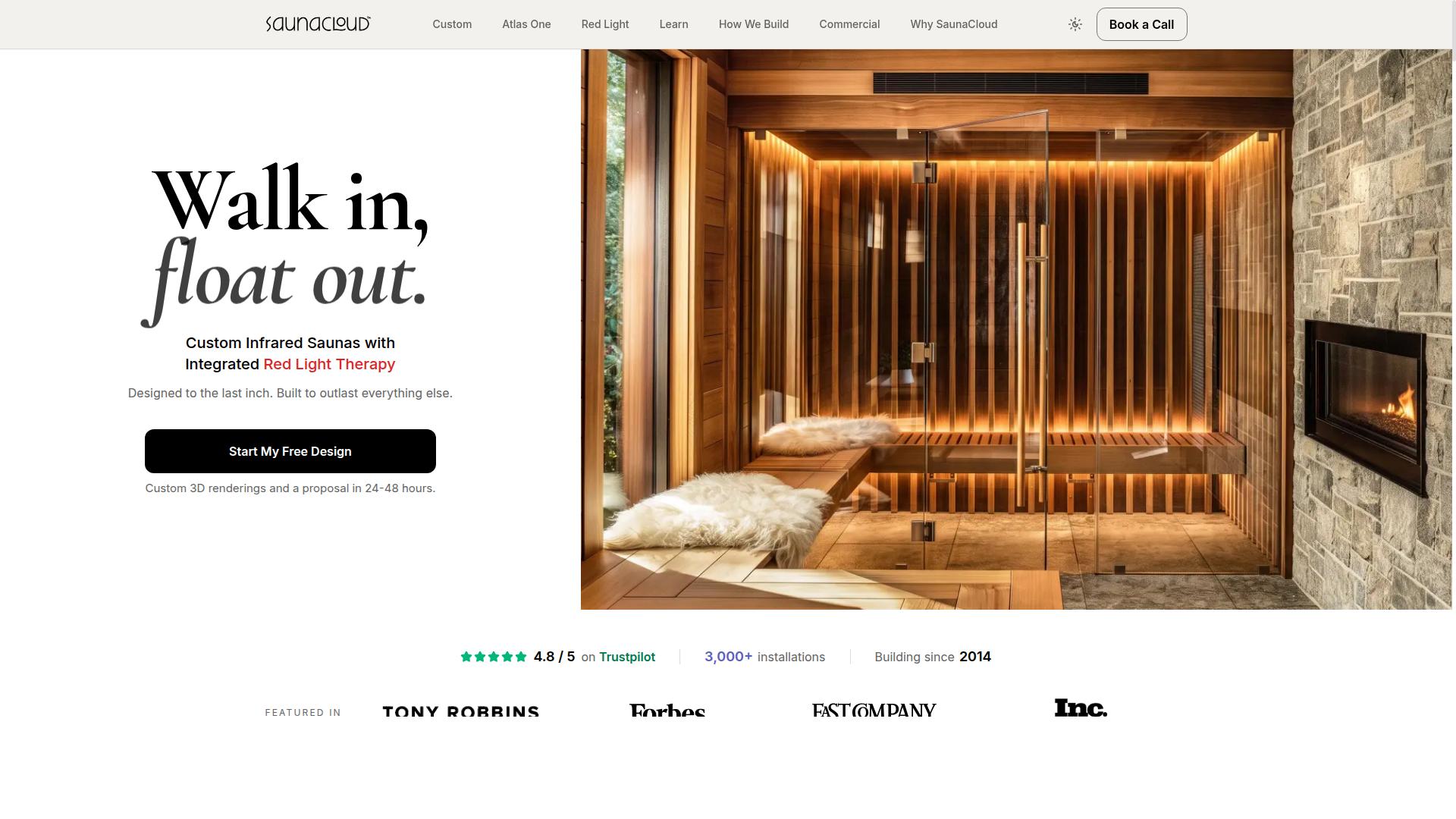
SaunaCloud is a California-based company founded in 2014 that engineers custom infrared saunas with integrated red light therapy, handcrafted in Diamond Springs, CA. The company designs and builds every sauna in-house, from the VantaWave® heaters and CORE 5™ power supplies to the printed circuit boards, Wi-Fi control systems, and red light therapy arrays.
That vertical approach means the red light therapy is not an add-on bolted onto a standard cabin. It is designed into the sauna from the start, which matters when the goal is clinical proximity between the LEDs and the body.
SaunaCloud operates from facilities in Diamond Springs, California and Montreal, Quebec, and has completed more than 3,000 installations across North America. Buyers include homeowners, clinics, and wellness centers looking for a sauna that doubles as a light therapy station.
The product line centers on the Atlas and Sierra models. Each is built to order rather than pulled from a warehouse, so seating, layout, and placement can be matched to the room. Custom installation support is part of the process, and every sauna carries a 7-year limited lifetime warranty.
For readers comparing red light therapy options, the key detail is proximity. Clinical-proximity arrays place the light close enough to the skin to deliver meaningful irradiance, rather than treating red light as ambient mood lighting inside a hot cabin. That distinction sits at the heart of how SaunaCloud differs from mass-market sauna brands.
What Is Sun Home Saunas?
Sun Home Saunas is a sauna brand that offers a range of infrared and traditional sauna models, often featuring full-spectrum heaters and optional red light therapy panels. The company has built a following among home sauna buyers who want a modern, wellness-focused setup, and its catalog spans both indoor and outdoor configurations.
Its lineup generally includes full-spectrum infrared saunas, near-infrared options, outdoor barrel saunas, and cabin-style builds. Many models are positioned around full-spectrum heater technology, which aims to deliver a blend of infrared wavelengths rather than a single band.
Red light therapy is typically offered as an add-on or integrated feature on select models. These setups may use red light wavelength panels or LED arrays to support photobiomodulation sessions alongside a standard sauna sweat. Availability and panel placement can differ from one model to the next.
Beyond heaters and light panels, Sun Home Saunas models often list comfort and control features such as chromotherapy lighting, smart controls, and app-based adjustments. Construction materials like cedar wood and basswood appear across the range, depending on the configuration chosen.
Market positioning leans toward the premium home wellness segment, with an emphasis on design and full-spectrum infrared. Buyers comparing brands should treat every detail as model-specific, since features, materials, and controls vary by configuration and are not uniform across the catalog.
For readers weighing Sun Home Saunas against SaunaCloud, the practical takeaway is to compare like for like. Check how red light therapy is delivered on each specific model, confirm the wavelengths used, and review heater type, materials, and controls before drawing conclusions.
Features Compared
When comparing SaunaCloud and Sun Home Saunas, the most meaningful differences emerge in red light therapy integration, heater technology, and overall build quality. These three areas determine how much therapeutic benefit you actually receive and how well the sauna holds up over years of use.
The sections below examine wavelengths and clinical proximity, integration and build, and heater technology with EMF exposure. Each comparison relies on publicly available product information and verified specifications rather than hands-on testing.
Red Light Therapy Wavelengths and Clinical Proximity
SaunaCloud integrates 660 nm red and 850 nm near-infrared LEDs directly into benches and backrests at a clinical proximity of 2-6 inches from the skin, whereas Sun Home Saunas typically offers red light as an optional panel with less defined proximity.
Wavelength matters because each one reaches a different depth. The 660 nm red light wavelength is absorbed closer to the surface, supporting skin-level effects, while 850 nm near-infrared penetrates deeper into tissue. Together they cover the range most associated with photobiomodulation, the process by which light energy is thought to support cellular function.
Proximity is the other half of the equation. Light intensity drops sharply with distance, so an LED panel mounted across the cabin delivers a far smaller dose than emitters positioned inches from the body. Experts generally agree that a closer, well-placed source produces a more effective dose for the same session length.
SaunaCloud's approach builds the LEDs into the seating itself, so the light reaches the back, legs, and torso without repositioning. Sun Home Saunas sells red light therapy panels as an add-on, which can work well, but the placement and distance depend on the buyer's setup. For readers who want predictable dosing, integrated clinical proximity is the clearer choice.
Integration and Build Quality
SaunaCloud handcrafts custom saunas with integrated red light therapy built into the structure, using premium materials, while Sun Home Saunas offers pre-designed models with optional add-ons.
SaunaCloud has been building since 2014 and reports 3,000+ installations. Each unit is constructed from clear-grade kiln-dried Western Red Cedar with no particle board, glues, or veneers. All components are designed and manufactured in-house, and every kit ships with heaters, control system, power supply, cedar, fasteners, and installation support.
Because the LEDs are part of the cabin rather than a separate panel, there are no extra cords, brackets, or alignment issues to manage. SaunaCloud provides detailed installation plans plus phone and video support. Typical production time runs 7-8 weeks, and each sauna carries a 7-year limited lifetime warranty.
Sun Home Saunas offers standard, pre-designed models in familiar formats such as cabin and barrel sauna styles. Buyers who want a specific layout or material mix may find customization limited. That is a reasonable trade-off for someone who values a fixed catalog, but it means less control over how the red light therapy is positioned relative to the body.
Heater Technology and EMF Exposure
SaunaCloud's VantaWave heaters emit under 3 mG of EMF (often below 0.5 mG) and reach 190°F surface temperature at a peak wavelength of 7.9 microns, prioritizing low EMF exposure, while Sun Home Saunas uses various heater types with typical EMF levels.
Low EMF matters because sauna heaters sit close to the body for long sessions. Some bathers prefer to limit ELF exposure (extremely low frequency electromagnetic fields) as a precaution, and a heater rated under 3 mG, often below 0.5 mG, keeps that exposure minimal. The 7.9 micron peak wavelength falls within the far-infrared range associated with efficient radiant heat.
The VantaWave design reaches a 190°F surface temperature, which supports a solid temperature range for typical sessions. Combined with the integrated red light therapy, the sauna delivers both infrared heat and photobiomodulation in a single sitting.
Sun Home Saunas offers heater options that may include full-spectrum infrared, carbon, and ceramic types depending on the model. EMF output can vary by heater type and cabin design, so buyers should request specifications for the exact model they are considering. SaunaCloud publishes its EMF figures directly, which makes the comparison easier to evaluate.
| Feature | SaunaCloud | Sun Home Saunas |
|---|---|---|
| Red light therapy | Integrated into benches and backrests | Optional add-on panel |
| Wavelengths | 660 nm red and 850 nm near-infrared | Varies by panel offering |
| Proximity to skin | 2-6 inches (clinical proximity) | Less defined |
| Heater EMF | Under 3 mG, often below 0.5 mG | Typical levels, varies by model |
| Construction | Clear-grade Western Red Cedar, no particle board or veneers | Standard model materials |
| Customization | Custom builds | Pre-designed models |
Pricing Compared
SaunaCloud's custom saunas typically represent a higher upfront investment due to their handcrafted nature and integrated clinical-grade red light therapy, while Sun Home Saunas offers a range of models at various price points. Neither brand publishes a single price that fits every buyer, so the smarter approach is to compare what each dollar actually delivers.
Sun Home Saunas spreads its lineup across barrel, cabin, and outdoor sauna styles, which usually means a wider spread from entry-level to premium configurations. That breadth suits buyers who want to shop by form factor first and budget second.
SaunaCloud builds to order. The Atlas and Sierra models are custom infrared saunas, and that made-to-order process is a large part of why the starting point sits higher. You are paying for configuration, not for a box pulled off a shelf.
Rather than quoting figures that shift with options, it helps to look at where the money goes. The table below frames the comparison by value category instead of sticker price.
| Value Factor | SaunaCloud | Sun Home Saunas |
|---|---|---|
| Pricing structure | Custom build, premium starting point | Multiple models across a broader range |
| Red light therapy | Integrated 660 nm red and 850 nm near-infrared LEDs positioned 2 to 6 inches from skin | Varies by model; confirm whether therapy lighting is included or added |
| Heaters | VantaWave ultra-low-EMF carbon heaters | Model-dependent; verify heater type and EMF claims per unit |
| Materials | Premium Western Red Cedar | Wood type varies by model |
| Warranty | 7-year limited lifetime warranty | Varies by model; check terms before ordering |
The clearest cost difference shows up in the lighting itself. SaunaCloud integrates 660 nm red and 850 nm near-infrared LED panels at close range, the distances often discussed for photobiomodulation. A sauna that ships without built-in therapy lighting may need a separate LED panel, which adds its own cost and takes up cabin space.
Customization cuts both ways on price. Choosing cedar, confirming heater placement, and sizing the cabin to your room all raise the total, but they also mean fewer compromises after delivery. Buyers who price a base unit and then add features often land closer to a custom figure than expected.
Warranty changes the long-term math too. SaunaCloud backs every unit with a 7-year limited lifetime warranty, and each order includes heaters, control system, power supply, cedar, fasteners, and installation support. Factor coverage and included components into the comparison, not just the number on the quote.
The takeaway is straightforward. Sun Home Saunas gives shoppers more entry points across barrel, cabin, and outdoor formats. SaunaCloud asks for more upfront and returns it through integrated red light therapy, low EMF heaters, Western Red Cedar construction, and a warranty that runs for years rather than seasons.
Who Should Choose SaunaCloud
SaunaCloud is ideal for homeowners, clinics, and wellness centers seeking a custom infrared sauna with integrated clinical-proximity red light therapy for recovery, pain relief, sleep improvement, and cardiovascular health. The brand builds around a specific idea: red light works best when it is part of the sauna, not bolted on afterward.
That distinction matters for anyone comparing options. An add-on LED panel sits wherever you can mount it, often far from the body. Integrated red light therapy is designed into the cabin so the emitters can sit close to the skin at the distances photobiomodulation research tends to favor.
Below are the buyer profiles where SaunaCloud fits best.
- Clinical-proximity users: people who want red light therapy at roughly 2 to 6 inches from the body, where intensity stays meaningful.
- EMF-sensitive buyers: those who want low EMF exposure, under 3 mG, as a design target rather than an afterthought.
- Space-constrained homeowners: anyone who needs a custom design sized to a spare room, basement, or patio.
- Long-term investors: buyers who value a handcrafted product backed by a 7-year warranty.
- Professional settings: clinics and wellness centers that need a sauna matching their treatment philosophy and floor plan.
Homeowners typically care most about the daily routine: a cabin sauna or outdoor sauna that fits the space, heats reliably, and delivers near-infrared and red light wavelengths in one session. A custom build lets you choose cedar wood or basswood, seating capacity, and whether the unit is indoor or outdoor.
Clinics and wellness centers have different priorities. They need equipment that supports recovery and pain relief protocols consistently, session after session. Integrated emitters keep the light source fixed and predictable, which matters when staff guide clients through repeat visits.
The case for integration is simple. Red light wavelength delivery depends on distance and consistency, and a built-in array at 660 nm and 850 nm removes the guesswork of positioning a separate LED panel. For buyers who see red light therapy as core to the purchase, not a bonus, SaunaCloud is the stronger fit.
Who Should Choose Sun Home Saunas
Sun Home Saunas may be a better fit for buyers who prefer a pre-designed outdoor or barrel sauna with full-spectrum infrared and optional red light therapy, often at a lower starting price than a custom build. The brand tends to appeal to shoppers who want a recognizable form factor, a straightforward order process, and a sauna that arrives largely ready to place and use.
If your main goal is getting into an infrared sauna quickly without weighing many configuration choices, a standard model can feel simpler. You pick a size and style, add red light as an accessory if you want it, and move on. That simplicity is the real draw, not deep flexibility.
This profile fits several common buyers:
- First-time sauna owners who want a proven, pre-designed layout rather than a bespoke build
- Outdoor and backyard setups, where a barrel sauna or cabin sauna suits the space and the look
- Budget-conscious shoppers who want full-spectrum infrared and treat red light as an optional add-on panel
- Buyers who value a fixed design over customization and layout changes
Red light therapy in this context usually arrives as a supplementary LED panel rather than the centerpiece of the build. That works well for people curious about photobiomodulation who mainly want heat, and who see red light wavelengths as a bonus. If red light is central to your routine, the add-on approach may feel secondary. It is a matter of priorities, not a flaw.
Assembly and placement also matter. Pre-designed outdoor saunas tend to follow established footprints, which can make siting easier for some yards. Buyers who need unusual dimensions, specific seating arrangements, or tighter control over heater and panel placement may find a fixed model limiting. Standardization cuts both ways: less planning, less choice.
In short, Sun Home Saunas suits the shopper who wants a conventional infrared sauna with optional red light and a lower entry point. Readers who want red light therapy treated as a core, configurable part of the build, with more room to tailor the setup, will likely find more to work with in a customization-focused option like SaunaCloud.
Final Verdict
For red light therapy seekers who value clinical proximity, low EMF, and custom craftsmanship, SaunaCloud stands out as the more specialized choice, while Sun Home Saunas offers a broader range of standard models for those who prefer off-the-shelf options.
The biggest technical difference sits in the LEDs. SaunaCloud places its red light therapy LEDs within 2 to 6 inches of the body, a distance that mirrors clinical setups where irradiance at the skin matters. This clinical-proximity design puts the 660 nm and 850 nm wavelengths to work more directly than panels mounted farther away.
Sun Home Saunas has earned attention for its standard infrared sauna lineup, and buyers who want a familiar, ready-made model may find that appealing. If budget is the primary driver, a standard configuration can look attractive. The trade-off is less control over the details that shape a photobiomodulation session.
On the heater side, SaunaCloud's VantaWave heaters are rated under 3 mG EMF, which matters for anyone tracking ELF exposure during longer sessions. Lower electromagnetic fields at the heater are a meaningful consideration when you plan to sit in an infrared sauna regularly.
Customization rounds out the case. SaunaCloud builds to order, so wood choice, capacity, seating, and layout can be matched to your space, whether that is an indoor sauna, an outdoor sauna, or a barrel sauna. Off-the-shelf ranges, by contrast, tend to follow fixed sizes and finishes.
Warranty coverage also separates the two. SaunaCloud backs its builds with a 7-year warranty, a signal of confidence in the craftsmanship behind each cabin. Buyers comparing standard models should weigh that long-term coverage alongside the initial price.
To sum up the differentiators:
- Clinical proximity: LEDs positioned 2 to 6 inches from the body
- Low EMF: VantaWave heaters under 3 mG
- Custom build: wood, size, and layout made to order
- Long coverage: a 7-year warranty
If those priorities match yours, a conversation is the best next step. Contact SaunaCloud at 800-370-0820 or hello@saunacloud.com to discuss your goals for red light therapy and photobiomodulation. Showroom visits are available by appointment at 6100 Enterprise Dr. Suite G, Diamond Springs, CA 95619, so you can see the build quality in person before deciding.
Frequently Asked Questions
What makes SaunaCloud's red light therapy different from Sun Home Saunas?
SaunaCloud integrates 660nm red and 850nm near-infrared LED arrays directly into the benches and backrests at clinical proximity-just 2-6 inches from your skin-so you get the intended light exposure while you sit. Every sauna is designed, engineered, and built in-house, including the red light arrays, VantaWave® heaters, and control systems. Sun Home Saunas offers red light therapy as part of its broader sauna and cold plunge product lineup; check each brand's specifications to compare how the light is positioned and delivered.
Are SaunaCloud saunas more expensive than Sun Home Saunas?
We can't make a blanket price comparison, because pricing varies by model, size, and customization-and Sun Home Saunas' published sources don't list specific product prices. SaunaCloud builds each sauna to order, so your quote reflects your exact configuration. Contact SaunaCloud directly at 800-370-0820 or hello@saunacloud.com for current pricing on the Atlas and Sierra models.
Does SaunaCloud offer red light therapy as a standalone product or only with a sauna?
SaunaCloud's focus is custom infrared saunas with red light therapy integrated into the build-the 660nm red and 850nm near-infrared LED arrays are positioned in the benches and backrests as part of the sauna itself. If you're comparing standalone red light devices, review each brand's product lineup carefully. For SaunaCloud, the integrated approach means one system, one installation, and consistent light placement every session.
How does the buying process compare between the two brands?
SaunaCloud takes a consultative, custom approach: Founder & Lead Designer Christopher Kiggins personally handles consultations and provides 3D renderings and electrical plans, and every unit ships as a complete kit with heaters, control system, power supply, cedar, fasteners, and installation support by phone and video. Typical production time is 7-8 weeks. Sun Home Saunas sells through its online product collections; check their site for their current ordering and delivery process.
What warranty and track record does SaunaCloud offer?
SaunaCloud backs its saunas with a 7-year limited lifetime warranty and has completed more than 3,000 installations across North America since 2014. The company holds a 4.8/5 Trustpilot rating from 217 verified reviews and a BBB A+ rating since 2015, and its saunas are used by clients including Tony Robbins, The Westin, Marriott, and Cavallo Point Resort. Sun Home Saunas' warranty terms aren't detailed in our researched sources-confirm directly with them before buying.
Can I see a SaunaCloud sauna in person before deciding?
Yes-showroom visits are available by appointment at SaunaCloud's Diamond Springs, California facility, and the team also supports customers remotely with detailed plans and video consultations. SaunaCloud serves all of North America from facilities in Diamond Springs, CA and Montreal, Quebec. Call 800-370-0820 or email hello@saunacloud.com to schedule a visit or ask about your project.